Sensitivity to initial conditions
The famous butterfly effect: a tiny difference—the flap of a butterfly’s wings in Brazil—can end up changing the outcome—a tornado in Texas. The error does not grow little by little, but exponentially.
An interactive introduction to chaos theory
Every cloud of dots you see here was born in a speck one thousandth of a unit wide. They all obey exactly the same equations and yet, within seconds, they have spread across the whole space. This is chaos: deterministic rules that produce behavior impossible to predict in the long run.
Click the background to release a new cloud
01 · Introduction
For centuries it was believed that if we knew the laws of a system and its present state, we could calculate its future as precisely as we liked. Chaos theory showed that this is not always true.
A chaotic system is a deterministic one—there is no randomness in its rules, and the same starting point always gives the same result—whose behavior is nonetheless unpredictable in practice. The reason is sensitive dependence on initial conditions: two almost identical starting states move apart exponentially fast. Since we can never measure the initial state with infinite precision, any small error keeps growing until it swamps the prediction.
But chaos is not pure disorder. Chaotic trajectories do not wander just anywhere: they stay confined to geometric structures of great beauty, the strange attractors, which have a fractal shape. There is order in chaos; what there isn’t is repetition.
The famous butterfly effect: a tiny difference—the flap of a butterfly’s wings in Brazil—can end up changing the outcome—a tornado in Texas. The error does not grow little by little, but exponentially.
The state of a system can be pictured as a point in phase space. In chaotic systems, trajectories converge on a set with fractal structure that is never traced the same way twice.
Chaos works the way a baker kneads dough: the dynamics stretch regions (pulling nearby points apart) and then fold them back onto themselves (keeping them bounded). Repeated forever, this mixes everything.
In a linear system, small causes have small effects and everything can be broken down into parts. Chaos needs nonlinearity—feedback—and, in continuous flows, at least three dimensions.
02 · The prediction horizon
The rate at which two neighboring trajectories move apart is measured by the Lyapunov exponent λ. If they start out differing by δ₀, after a time t the difference is approximately
If λ > 0, the system is chaotic. The consequence is counterintuitive: better measurements buy us very little extra time, because the horizon grows only with the logarithm of the precision. Try it with the simplified model alongside, inspired by weather forecasting.
03 · A little history
While studying the stability of the solar system, he discovers that the motion of three mutually attracting bodies can be so intricate that “small differences in the initial conditions produce very great ones in the final phenomena.”
When he reruns a weather simulation typing in 0.506 instead of 0.506127, the forecast diverges completely. He publishes “Deterministic Nonperiodic Flow,” the founding paper of modern chaos.
They propose that turbulence in fluids arises from strange attractors, and give the concept its name.
“Period Three Implies Chaos”: Li and Yorke give the field its name. May shows that an equation as simple as the logistic map, used to model populations, contains the entire repertoire of chaos.
He discovers that period-doubling cascades always follow the same ratio, δ ≈ 4.6692…, whatever the system: a new universal constant of nature.
Benoît Mandelbrot popularizes fractal geometry, and computers make it possible, for the first time, to see strange attractors. Chaos reaches physics, biology, chemistry and economics.
04 · Simulations
Every simulation is computed in real time in your browser, and you can play with it: change the parameters, drag, zoom in and see for yourself how a minuscule difference changes everything.
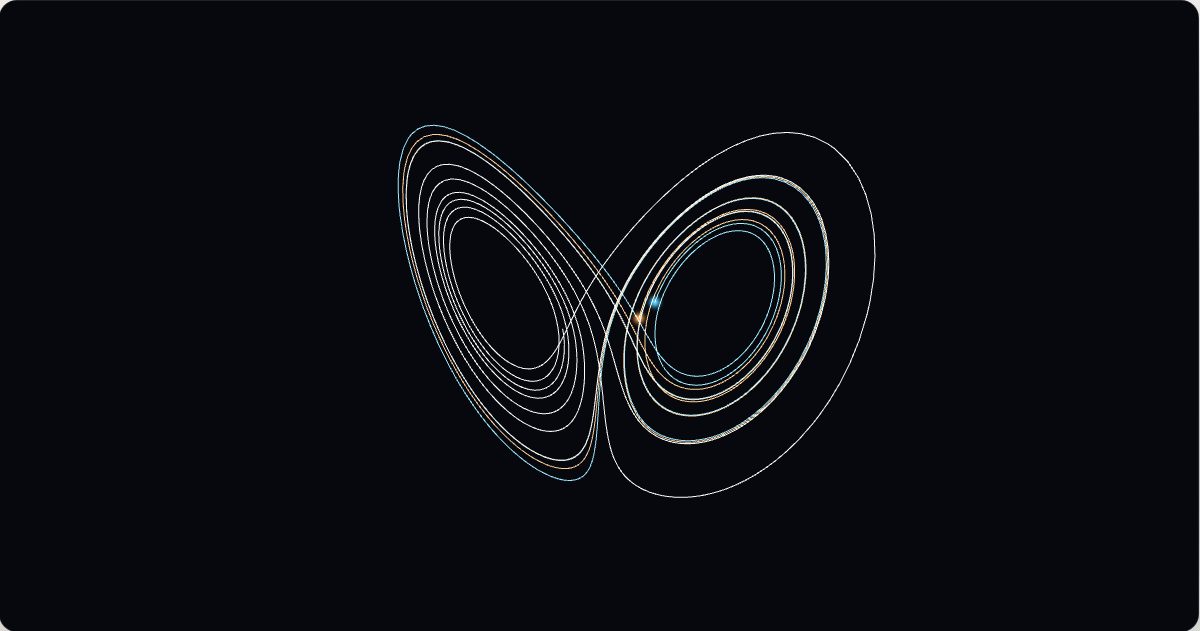
Lorenz, Rössler, Aizawa, Thomas and Halvorsen in 3D, with the butterfly effect measured live.

A swarm of nearly identical pendulums that starts out moving as one and ends up fanned out.
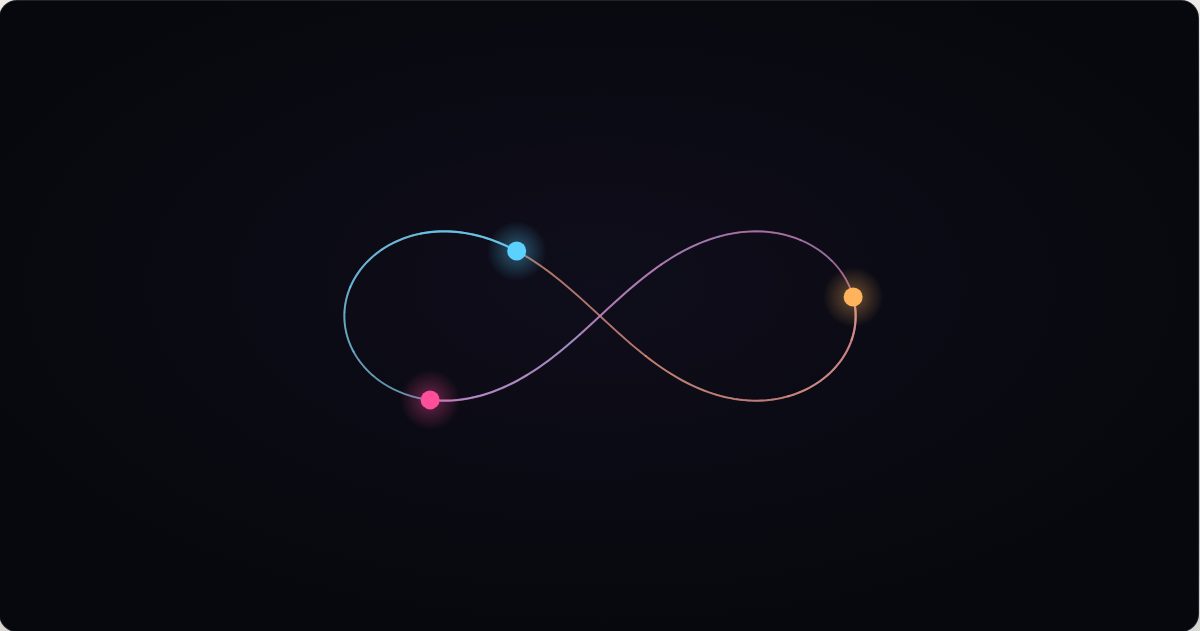
Three bodies bound by gravity: exact choreographies and chaotic dances, with a twin system that gives the chaos away.
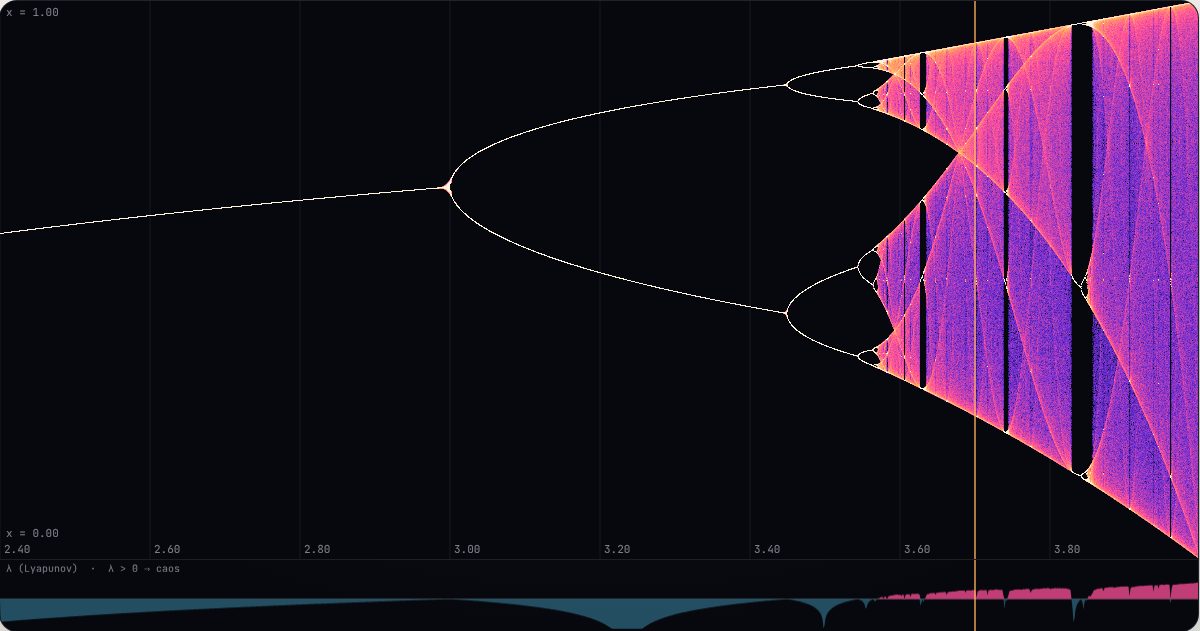
A zoomable bifurcation diagram, the Lyapunov exponent and the cobweb plot of a one-line equation.

A horseshoe that, when you zoom in, turns out to be made of lines within lines, without end.

Two lines of trigonometry iterated millions of times: generative art you can download.
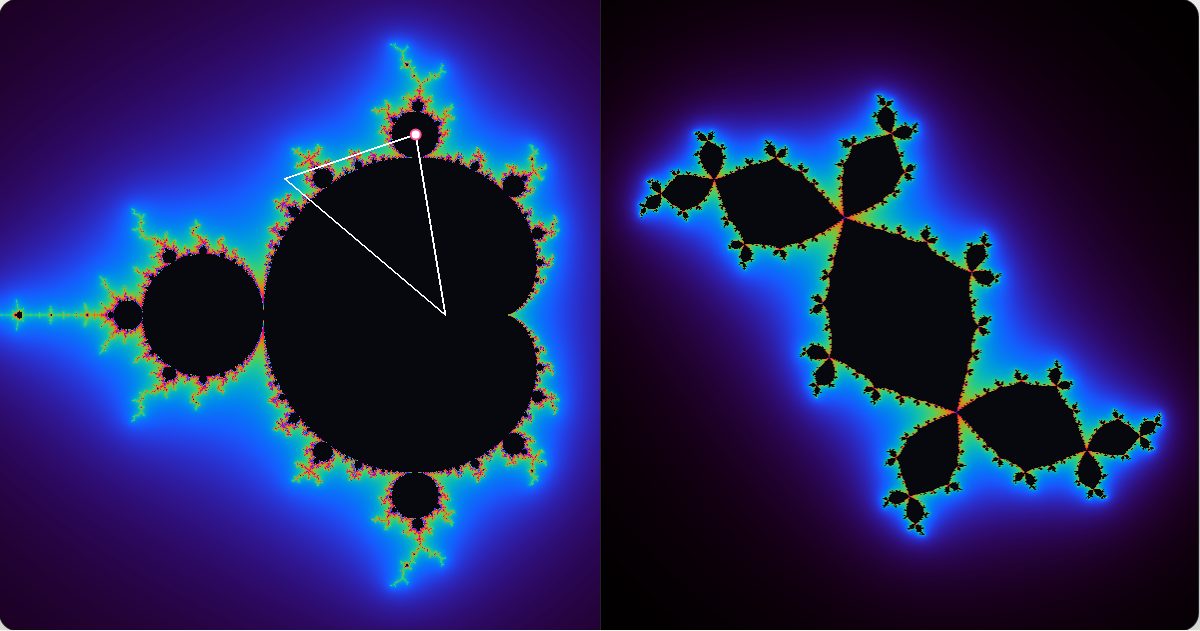
The two sets linked together: point at a spot in the Mandelbrot set and its Julia set appears.
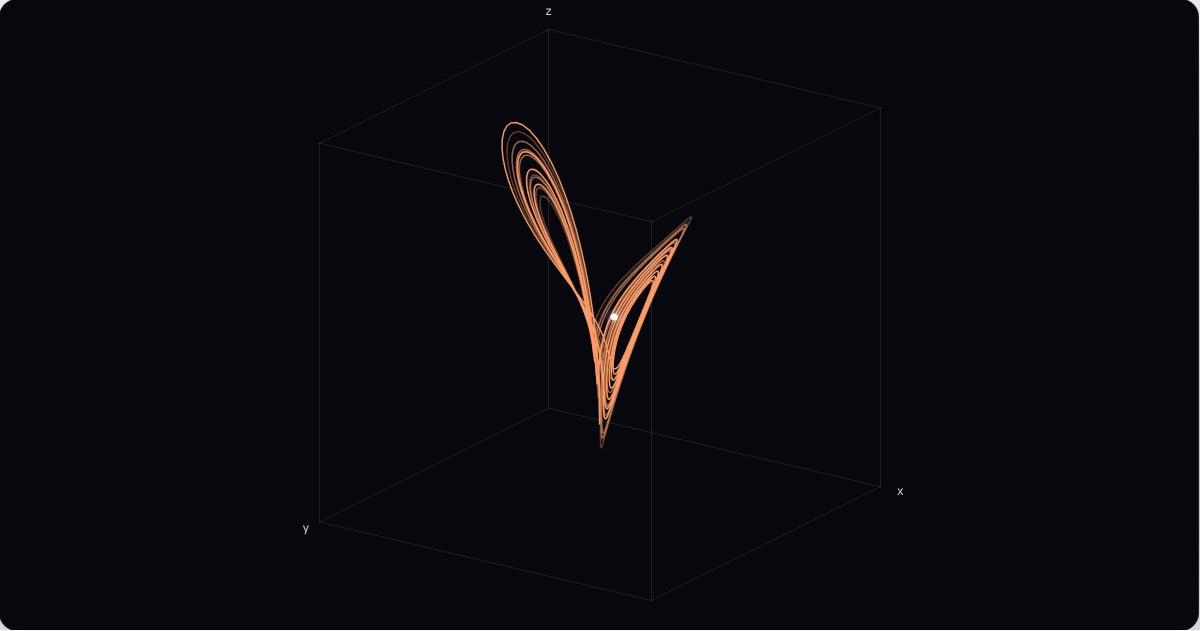
Write your own equations, tune the parameters and share the result with a link.
05 · Chaos all around you
This is why reliable forecasts don’t reach beyond a week or two, and why weather services run ensembles of dozens of simulations with slightly different initial conditions.
Planetary orbits are chaotic on timescales of millions of years: we cannot know for certain where the Earth will be 100 million years from now.
Populations of insects, plankton or rodents show cycles and irregular fluctuations that the logistic map and its relatives help to explain.
Some arrhythmias have been studied as transitions to chaotic dynamics; neural activity blends order and chaos in subtle ways.
The smoke from a candle, a river, the air behind an airplane: turbulence is one of the great unsolved problems of physics.
Chaotic circuits (such as Chua’s), lasers, pseudorandom number generation, cryptography and the control of unstable systems.
One important caveat: being irregular does not make something chaotic. Deterministic chaos is a precise concept—a positive Lyapunov exponent, a bounded attractor—and in many real systems (such as financial markets) it is hard to tell apart from pure noise.
06 · Community
Chaos is also something you learn by playing. Test your intuition against unpredictable systems, earn butterflies, climb the leaderboard, chat in the forum and discover books and films to keep exploring.
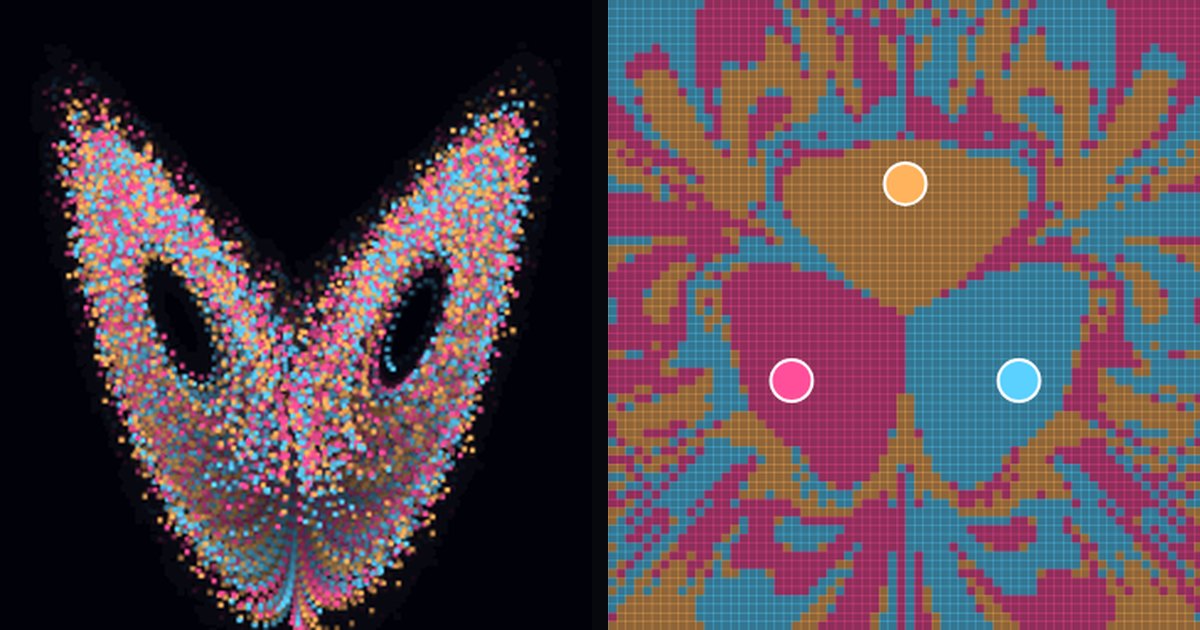
Five one-minute experiments, no formulas: for all ages.
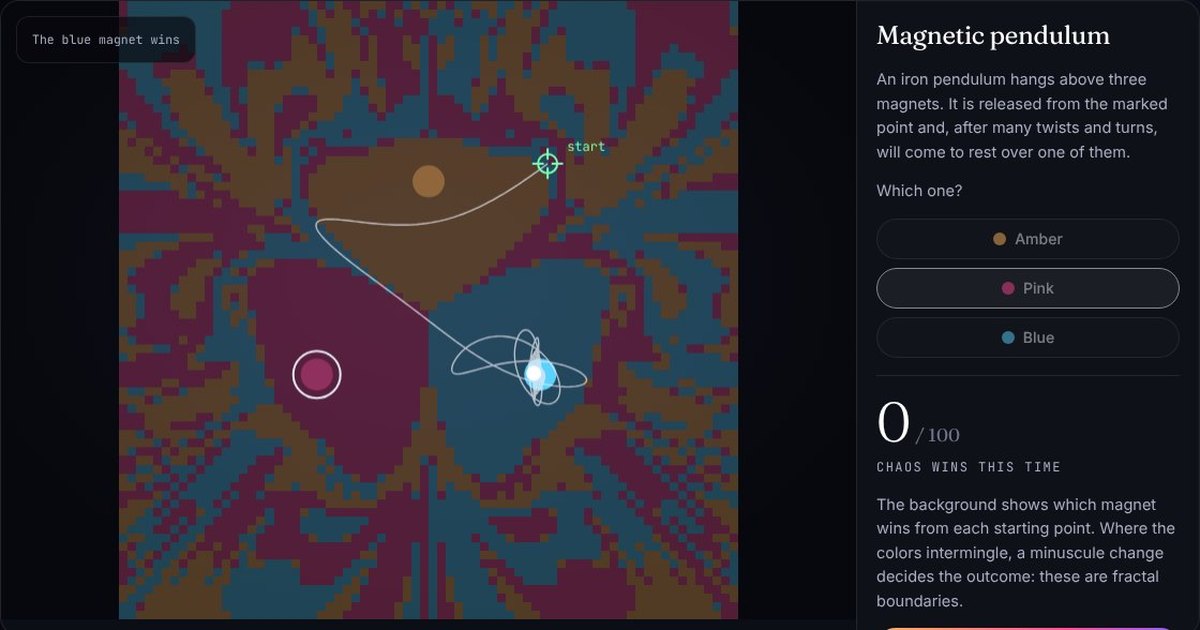
Four prediction games, a daily challenge that is the same for everyone and a leaderboard counted in butterflies.

A forum for sharing simulations, getting questions answered and discussing the challenges, plus the community leaderboard.
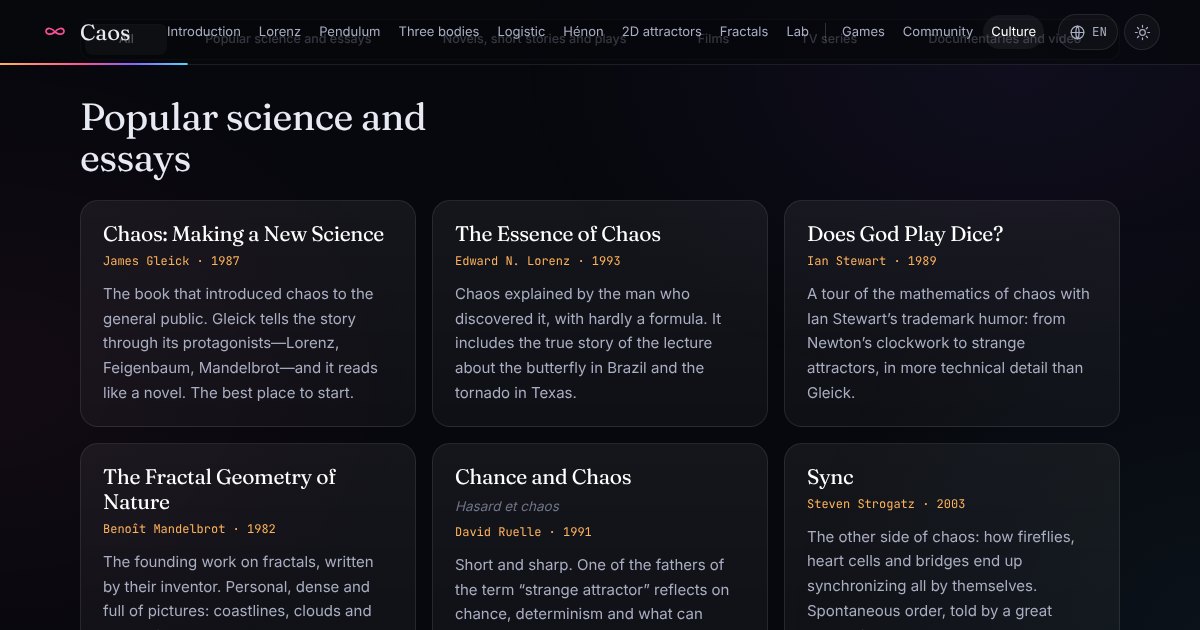
Thirty books, films, series and documentaries to keep pulling the thread, voted on by the community.